Valve Bags Case Study: Cutting Dust and Breakage in Cement Packing
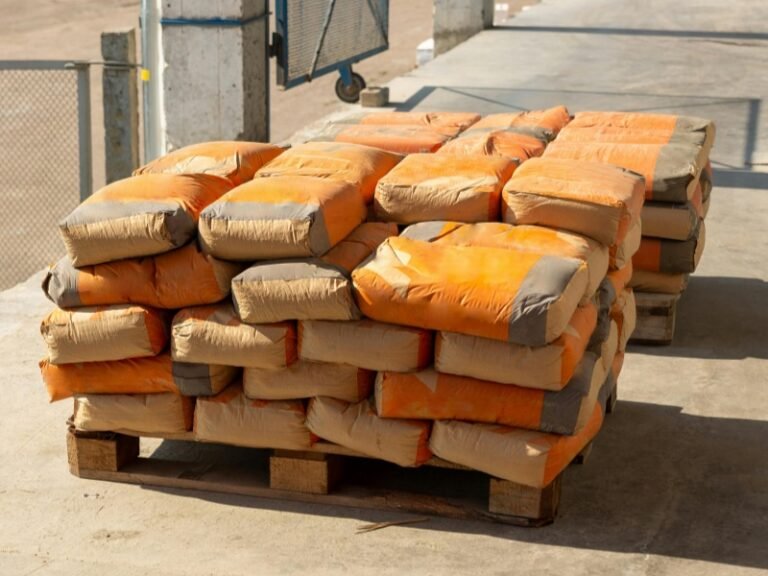
This valve bags case study follows a cement and dry-mortar producer in the Middle East that replaced open-mouth woven sacks with 50 kg laminated valve bags on three packing lines. Over six months, breakage, filling dust, and packing time all fell, even though the product and the filling machines stayed the same.
Cement is one of the hardest products to pack. It is heavy, abrasive, and absorbs moisture quickly. Any weak point in a bag shows up fast as dust, spillage, and failed pallets.
The Customer and the Problem
The customer is a regional building-materials group producing ordinary Portland cement and dry mortar for domestic sales and for sea freight to East Africa. Its three lines ran 50 kg open-mouth woven sacks at 80 GSM, unlaminated, closed with sewing thread.
On paper, the bags met the strength requirement. On the floor, the same three problems came back every shift.
Four Problems with the Open-Mouth Format
- Dust at the filling spout. Open-mouth bags have to be held open under the spout, so fine cement escapes during every fill. The plant ran two extraction points per line and still had visible dust in the packing hall.
- Seam and gusset failure. Sewing needles create a line of holes along the top seam. Under a 50 kg load and a 1.2 m drop onto a pallet, that seam was the first part to open.
- Moisture pickup in port storage. Unlaminated PP fabric is not a moisture barrier. Bags held in a humid warehouse before container loading picked up water and caked at the edges.
- Manual handling and line speed. Every bag had to be positioned, held, filled, and then fed to the sewing head. The line topped out at roughly 1,100 bags per hour and needed two operators at the spout.
What We Changed
We moved the account from open-mouth to valve bags and kept everything else in the plant unchanged.
- Fabric: 95 GSM PP woven, laminated on the outer face for stiffness and print quality
- Liner: 25 µm PE inner liner for moisture protection during sea freight
- Valve: dust-proof inner valve, 90 mm opening, matched to the existing filling spout
- Size: 50 kg fill, 55 × 90 cm, gusseted base
- Print: 4-color flexo, including product grade, batch field, and handling marks
The valve bag specification used here was built from the plant’s existing spout dimensions, not from a catalogue size.
How the Trial Was Run
- Sample stage. Weavota shipped 200 empty bags for spout fitting and print approval before any production run.
- Line trial. 5,000 bags ran on one line for two weeks, with drop tests from 1.2 m onto concrete and a 48-hour humidity test at 85% relative humidity.
- Full switch. After the trial passed, all three lines moved to valve bags over one month, with the old open-mouth stock used up rather than scrapped.
Results After Six Months
- Bag breakage: down from 1.8% to 0.4% of bags filled, measured at the palletizer
- Filling rate: up from about 1,100 to 1,340 bags per hour on the same machine
- Product loss: spillage and sweepings down from roughly 0.6% to 0.15% of packed weight
- Dust: one of the two extraction points per line was taken out of service
- Storage: 60 days in port before loading, no caking at the bag edges
- Labour: one operator at the spout instead of two
Why Valve Bags Fixed These Problems
A valve bag is filled through a self-closing sleeve instead of an open mouth. The filling spout pushes into the valve, the bag fills, and the internal pressure closes the sleeve behind the spout. Three things follow from that:
- There is no open mouth for dust to escape from, so the packing hall stays cleaner.
- There is no sewn seam along the top, which removes the weakest point of the old bag.
- The bag can be presented to the spout mechanically instead of being held by hand, which is where the extra throughput comes from.
What Other Packers Should Check Before Switching
Filling machine compatibility
Valve bags need a spout that matches the valve opening. Most cement packers already have one, but the valve size, the spout diameter, and the filling pressure all have to be confirmed before ordering.
Fabric weight and liner
95 GSM with a 25 µm liner suited this product. A finer powder, a hotter climate, or a longer sea route may need a heavier liner or a different laminate.
Pallet patterns and drop height
Valve bags stack differently from open-mouth sacks because the bag profile is flatter. Pallet patterns usually need one trial run to settle.
Testing before the full order
The line trial above cost two weeks and 5,000 bags. It is far cheaper than discovering a valve mismatch after a full container has been packed.
How Weavota Can Help
Weavota manufactures valve bags for cement, mortar, minerals, and powdered chemicals, from 5 kg retail packs to 50 kg export sacks. For packers in this segment we provide:
- Valve bags from 65 to 150 GSM, laminated or unlaminated
- PE liners, dust-proof inner valves, and spout-matched valve sizes
- Up to 6-color flexographic printing
- In-house drop, burst, and moisture testing before shipment
- ISO 9001 certified production on Starlinger and W&H lines
- Factory-direct pricing with no trading company in between
The numbers in this valve bags case study came from one customer’s packing lines. Your own results will depend on your product, your spout, and your storage conditions, which is why we run a sample and line trial first.
Need Valve Bags for Cement or Mortar?
Send us your bag size, fill weight, and spout dimensions and we will quote a matching valve bag.
Request a quote for cement valve bags →
This case study is part of our Case Studies series. For more packaging insights, explore our other case studies.